As a fully insured and licensed company, Conquer Termites complies with all the requirements and guidance given by our insurer – Rapid Solutions, the Australian Standards and the manufacturer’s instructions.
But there are real limitations to the work we conduct. It is important that you, our customer clearly understand these, so we can work together for the right outcome:
Terms & limitations:
1. THIS IS A VISUAL INSPECTION ONLY in accord with the requirements of AS 4349.3 Inspection of buildings Part 3: Timber pest inspections. Visual inspection was limited to those areas and sections of the property to which reasonable access (See Definition) was both available and permitted on the date of Inspection. The inspection DID NOT include breaking apart, dismantling, removing or moving objects including, but not limited to, foliage, mouldings, roof insulation/sisalation, floor or wall coverings, sidings, ceilings, floors, furnishings, appliances or personal possessions. The inspector CANNOT see inside walls, between floors, inside skillion roofing, inside the eaves, behind stored goods in cupboards, and in other areas that are concealed or obstructed.
The inspector DID NOT dig, gouge, force or perform any other invasive procedures. An invasive inspection will not be performed unless a separate contract is entered into. In an occupied property it must be understood that furnishings or household items may be concealing evidence of Timber Pests which may only be revealed when the items are moved or removed. In the case of Strata type properties only the interior of the unit is inspected.
2. SCOPE OF REPORT: This Report is confined to reporting on the discovery, or non-discovery, of infestation and/or damage caused by subterranean and damp wood termites (white ants), borers of seasoned timber and wood decay fungi (hereinafter referred to as “Timber Pests”), present on the date of the Inspection. The Inspection did not cover any other pests and this Report does not comment on them. Dry wood termites (Family: KALOTERMITIDAE) and European House Borer (Hylotrupes bujulus Linnaeus) were excluded from the Inspection, but have been reported on if, in the course of the Inspection, any visual evidence of infestation happened to be found. If Cryptotermes brevis (West Indian Dry Wood Termite) or Hylotrupes bujulus Linnaeus are discovered we are required by law to notify Government Authorities. If reported a special purpose report may be necessary.
3. LIMITATIONS: Nothing contained in the Report implies that any inaccessible or partly inaccessible areas or sections of the property being inspected by the Inspector on the date of the inspection were not, or have not been, infested by Timber Pests. Accordingly, this Report is not a guarantee that an infestation and/or damage does not exist in any inaccessible or partly inaccessible areas or sections of the property. Nor is it a guarantee that a future infestation of Timber Pests will not occur or be found.
4. DETERMINING EXTENT OF DAMAGE: TThe Report is NOT a structural damage Report. We claim no expertise in building and any inexpert opinion we give on timber damage CANNOT be relied upon. The Report will not state the full extent of any timber pest damage. The Report will state timber damage found as ‘slight’, `moderate’, `moderate to extensive’ or ‘extensive’. This information is not the opinion of an expert. If any evidence of Timber Pest activity and/or damage resulting from Timber Pest activity is reported either in the structure(s) or the grounds of the property, then You must assume that there may be concealed structural damage within the building(s). This concealed damage may only be found when wall linings, cladding or insulation are removed to reveal previously concealed timbers. An invasive Timber Pest Inspection (for which a separate contract is required) is strongly recommended and You should arrange for a qualified person such as a Builder, Engineer, or Architect to carry out a structural inspection and to determine the full extent of the damage and the extent of repairs that may be required. You agree that neither We nor the individual conducting the Inspection is responsible or liable for the repair of any damage whether disclosed by the report or not.
5. MOULD: Mildew and non-wood decay fungi is commonly known as Mould and is not considered a Timber Pest. However, Mould and its spores may cause health problems or allergic reactions such as asthma and dermatitis in some people. No inspection for Mould was carried out at the property and no report on the presence or absence of Mould is provided. Should any evidence of Mould happen to be noticed during the inspection, it will be noted in the Other Information (5.11) section of this report. If Mould is noted as present within the property and you are concerned as to the possible health risk resulting from its presence then you should seek advice from your local Council, State or Commonwealth Government Health Department or a qualified expert such as an Industry Hygienist.
6. DISCLAIMER OF LIABILITY: No liability shall be accepted on account of failure of the Report to notify any Termite activity and/or damage present at or prior to the date of the Report in any areas(s) or section(s) of the subject property physically inaccessible for inspection, or to which access for Inspection is denied by or to the Licensed Inspector (including but not limited to any area(s) or section(s) so specified by the Report).
7. DISCLAIMER OF LIABILITY TO THIRD PARTIES: This Report is made solely for the use and benefit of the Client named on the front of this report. No liability or responsibility whatsoever, in contract or tort, is accepted to any third party who may rely on the report wholly or in part. Any third party acting or relying on this Report, in whole or in part, does so at their own risk.
8. COMPLAINTS PROCEDURE: TIn the event of any dispute or claim arising out of, or relating to the Inspection or the Report, or any alleged negligent act or omission on Our part or on the part of the individual conducting the Inspection, either party may give written Notice of the dispute or claim to the other party. If the dispute is not resolved within twenty-one (21) days from the service of the written Notice then either party may refer the dispute or claim to a mediator nominated by Us. The cost shall be met equally by both parties or as agreed as part of the mediated settlement. Should the dispute or claim not to be resolved by mediation then one or other of the parties may refer the dispute or claim to the Institute of Arbitrators and Mediators of Australia who will appoint an Arbitrator who will resolve the dispute by arbitration. The Arbitrator will also determine what costs each of the parties are to pay.
IMPORTANT MAINTENANCE ADVICE REGARDING INTEGRATED PEST MANAGEMENT FOR PROTECTING AGAINST TIMBER PESTS:
We further advise that you engage a professional pest control firm to provide a termite management program in accord with AS 3660 to minimise the risk of termite attack. There is no way of preventing termite attack. Even AS 3660 advises that “the provision of a complete termite barrier will impede and discourage termite entry into a building. It cannot prevent termite attack. Termites can still bridge or breach barriers but they can be detected more readily during routine inspections.” You should read and understand the following important information. It will help explain what is involved in a timber pest inspection, the difficulties faced by a timber pest inspector and why it is not possible to guarantee that a property is free of timber pests. It also details important information about what you can do to help protect your property from timber pests. This information forms an integral part of the report.
REASONABLE ACCESS
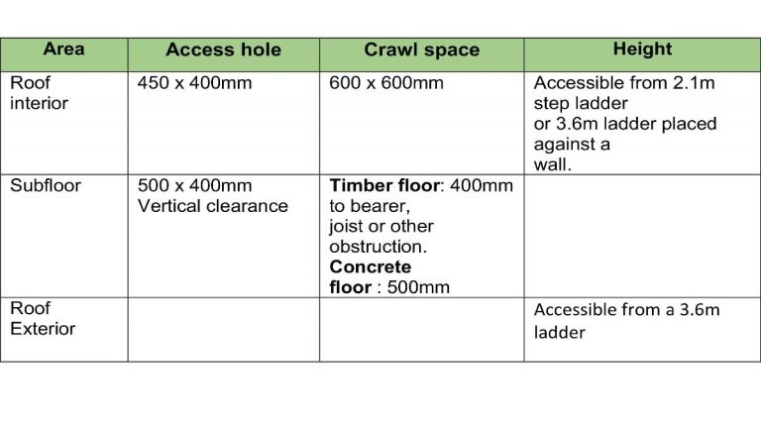
Only areas to which reasonable access is available were inspected. The Australian Standard 4349.3 defines reasonable access as “areas where safe, unobstructed access is provided and the minimum clearances specified in the Table below are available or, where these clearances are not available, areas within the consultant’s unobstructed line of sight and within arm’s length. Reasonable access does not include removing screws and bolts to access covers.” Reasonable access does not include the use of destructive or invasive inspection methods. Nor does reasonable access include cutting or making access traps, or moving heavy furniture or stored goods.